To print this article, all you need is to be registered or login on Mondaq.com.
General Overview on HPP Law: The Government of
Indonesia issued Law No. 7 of 2021 on Harmonization of Taxation
Regulation (Harmonisasi Peraturan Perpajakan or
“HPP Law“), which amended several
material issues in the Indonesian Taxation Law. HPP Law was
promulgated on 29 October 2021 and most of the provisions will
become effective in the fiscal year 2022.
Similar to Job Creation Law, HPP law mainly provides amendments
to some provisions under the preceding tax laws
(i.e., Law No. 11 of 1995 on Excise, as amended by
Law No. 39 of 2007, Law No. 6 of 1983 on General Provisions and
Procedures on Taxation, as lastly amended by Law No. 16 of 2009),
as well as introduces new taxes such as the new Carbon Tax.
These provisions and the effective dates of such amendments
and/or new provisions are as follows:
- amendment to the General Provisions and Tax Procedures,
effective as of 29 October 2021; - amendment to the Income Tax Law, effective on the start of
fiscal year 2022 (i.e., 1 January 2022); - amendment to the Value Added Tax Law, effective as of 1 April
2022; - Taxpayer Voluntary Disclosure Program for the period between 1
January and 30 June 2022; - Carbon Tax, effective as of 1 April 2022; and
- Excise Law, effective as of 29 October 2022.
Aim of the HPP Law: Based on Article 1 (2) of
HPP Law, its issuance is aiming at:
- promoting sustainable economic growth and supporting
acceleration of the economic recovery; - optimizing the state revenue;
- providing fairer tax system and legal certainty;
- stipulating administrative reform and tax base expansion;
and - improving voluntary compliance of taxpayers.
Although the law is made to promote sustainable economic growth
and recovery from the pandemic induced effect, the Indonesian
general public and businesses’ most concern of the direct
economic effect of HPP Law, including the proposed raise of VAT
from 10% to 11%. Many experts and practitioners view that the law
was issued to provide the government with a “source of
funding” to cut the deficit in the state budget during
Covid-19 pandemic. This appears to be a non-traditional and unique
approach, especially compared to other countries’ approaches on
taxation during this time.
Although the spirit of HPP Law looks good on the surface, the
long-term effect on businesses and the public alike might be
concerning.
Scope of Analysis: In this article, we provide
a summary of the key points of the amendments and new provisions of
HPP Law. Given that the law provides many substantial changes to
taxation laws, we address these key points in two separate
articles. In this volume, we only address the amendments to (i)
Income Tax Law and (ii) VAT Law.
A. Amendment to the Income Tax Law
HPP Law amended some provisions of Law No. 7 of 1983 on Income
Tax, which was lastly amended by Law No. 11 of 2020 on Job Creation
(“Income Tax Law“)
The key amendments include that on the income tax rates, which
are determined progressively based on the income band
(“Income Band“).
Pursuant to Art. 3 (7) of HPP Law, the minimum and maximum
thresholds of income band, subject to the progressive income tax
rates, are increased to IDR60 million as the minimum threshold, and
IDR50 billion as the maximum threshold (“Income
Band“). Such changes are reflected in the new tax
rates:
Please note that the Income Band refers to the total annual
income as reported in the Taxpayer’s Annual Tax Return.
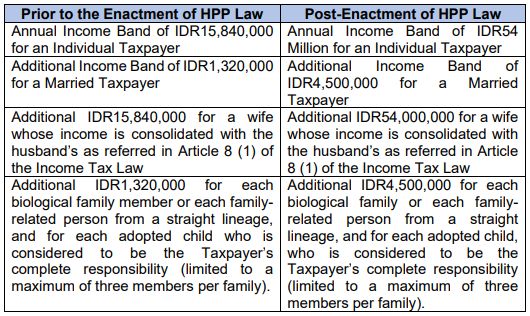
HPP law also introduces the following provisions on the
exclusion of certain amounts in the calculation of the progressive
Income Band:
Furthermore, HPP Law stipulates that the business income of an
Individual Taxpayer with a gross turnover of up to IDR500 million
in a single tax year is categorized under the Micro, Small, Medium
Enterprises (MSME) tax rate, and will not be subject to the income
tax.
Lastly, the Corporate Income Tax Rate for Corporate Taxpayer
will remain at 22% in 2022, as the initially planned 20% rate is
cancelled.
B. Amendment to VAT Law
Pursuant to Article 17 (2) of HPP Law, the provisions amending
the VAT Law shall become effective as of 1 April 2022. The changes
in VAT Law are as follows:
- Expansion of Tax Base by Removing Most of the Negative
List on VAT Exemption: Article 4 (1) of the HPP Law
provides certain goods and services that are no longer
exempted from VAT with the following details:- Goods and/or services that are removed from VAT
exemption: taxable goods from mining and drilling results
taken directly from the sources, which exclude coal, gold bars
other than those for the government’s forex reserve,
non-advertising broadcasting services, postal services, public
phone services, and money transfer by postal services. - Goods and/or services, which remain exempted from VAT
but subject to other requirements:
- Subject to Regional Tax: F&B served in
hotels or restaurants, hotel parking, catering, and
arts-and-entertainment services; - Public services provided by the government that cannot be
provided by other parties.
- Subject to Regional Tax: F&B served in
- VAT-able strategic goods and/or services exempted from
VAT: basic necessities, medical services, financial
services, insurance services, education services, non-profit social
services, public transportation of all modes of transportation, and
manpower services.
Possible Impact: Removal of these goods and
services from VAT exemption can be both beneficial or less
beneficial for various stakeholders.From the consumers’ point of view, this could be burdensome,
especially in terms of fulfilling their basic needs. From the
perspective of the government that has witnessed a progress of
business development in MSME sectors, specifically F&B, the
pandemic has also caused so much negative impact on the
economy. - Goods and/or services that are removed from VAT
- The Changes in VAT Rate: The most worrisome
change in the VAT Law under HPP Law is the change of VAT rate that
would be gradually increased from 10% to 12%.The rate increase from 10% to 11% will be effective as of 1
April 2022, and that the increase from 11% to 12%
will be effective no later than 1 January 2025.
C. NLP Closing Remarks on HPP Law
Amendments on taxation provisions under HPP Law are quite
controversial and will definitely have substantial impacts on the
daily life and businesses in Indonesia. In the eyes of the
Indonesian tax authority and the Ministry of Finance, such changes
are not always unbeneficial as they support the middle to
lower-middle classes with the haves paying more taxes.
It remains to be seen how the enforcement of the law will impact
on the public and state income. Many people still have a great
concern over the inflation caused by this tax reform that will
likely increase prices and living costs in Indonesia.
The content of this article is intended to provide a general
guide to the subject matter. Specialist advice should be sought
about your specific circumstances.